26-06-2025
Why KOL Tiering Matters in Medical Affairs and How konectar Gets It Right
Engaging with the right Key Opinion Leaders (KOLs) is a core responsibility for Medical Affairs teams.
Engagement with the right experts supports scientific exchange, shapes product narratives, and drives stronger field insights. But identifying which experts to engage and when - isn’t always clear. Influence shifts. Clinical relevance changes. And not every expert plays the same role across regions or institutions.
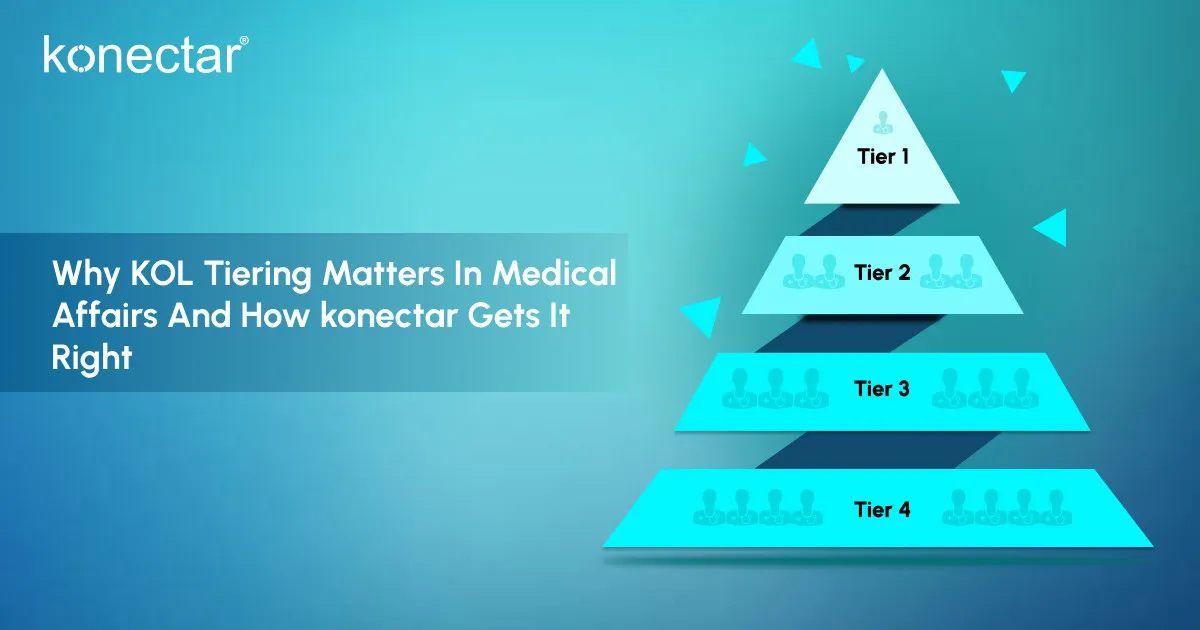
A well-defined KOL tiering model helps bring clarity. It organizes experts by relevance, therapeutic alignment, and impact. This makes it easier for teams to prioritize who to engage and how to approach them.
Influence isn’t one-dimensional. Publications and speaking events matter. However, so do leadership roles, peer recognition, and the degree to which an expert aligns with medical strategy. Without a system to assess this, teams face long lists with no clear direction.
konectar solves this challenge. konectar is an AI-powered KOL management platform designed specifically for Medical Affairs teams. It uses real-world data and adaptive intelligence to segment experts, offering insights that reduce reliance on standalone HCP segmentation tools.
In this article
- What Is KOL Tiering and Why Does It Matter
- The Hidden Gaps in Conventional KOL Tiering
- How konectar Gets KOL Tiering Right
- Conclusion: Turning Tiering Into Strategic Advantage
What Is KOL Tiering and Why Does It Matter
Tiering is more than just categorizing KOLs as high, medium, or low. In a Medical Affairs context, it’s about understanding the specific value each expert brings. It’s a system that gives structure to influence, which acts as a backbone of a practical medical affairs targeting strategy.
At its core, KOL tiering helps teams answer critical questions:
- Who are the scientific leaders shaping thinking in our therapeutic area?
- Which voices are trusted at the regional, institutional, or community level?
- Who can support a launch, provide insight on trial feasibility, or help refine messaging?
Each answer refers to a distinct type of KOL. Tiering brings this diversity into focus. It allows teams to move from “who’s well-known” to “who’s most relevant”. This tiering is based on clear criteria like clinical trial involvement, digital activity, publication history, and conference participation.
For U.S.-based teams, tiering also plays a compliance role. Engagement strategies must reflect fair market value, provide balanced access, and be supported by a documented rationale. When Medical Affairs teams can demonstrate that outreach is based on structured tiering and not personal preferences or guesswork, it supports ethical operations and audit readiness.
Beyond compliance, structured tiering improves how teams work every day. MSLs use it to plan meaningful, targeted interactions. Strategic leaders rely on it to monitor influence in emerging areas. Field teams depend on it to focus their time where it matters most. This clarity improves engagement quality and resource efficiency across the board.
Medical Affairs teams that adopt formal tiering frameworks see a measurable impact. This is especially true when tiering is paired with a scalable pharma KOL ranking system that applies consistent criteria across teams.
The Hidden Gaps in Conventional KOL Tiering
Most Medical Affairs teams recognize the importance of KOL tiering, but implementing it effectively is often more complicated. Many teams still rely on legacy approaches that are time-consuming and don’t reflect how influence evolves.
One of the most common challenges is the use of manual processes. Teams often manage KOL data across spreadsheets, CRM exports, and email threads. Not only is this inefficient, but it also increases the risk of outdated insights and data entry errors. Without a centralized system, there’s no clear way to track who made updates or which file reflects the most current information.
Another barrier is siloed data. KOL insights are often fragmented across various functions, including Field Medical, Commercial, and Compliance. Without a unified platform, it's difficult to form a complete view of any given expert. This fragmentation can lead to duplicative outreach, missed opportunities, and inconsistent messaging.
There’s also the issue of inconsistent tiering criteria. Some teams base tiers on publication count, while others prioritize speaking engagements or clinical trial involvement. Without standardized parameters, tiering becomes subjective. This creates internal confusion and complicates the reporting process.
How konectar Gets KOL Tiering Right
KOL tiering is most valuable when it helps Medical Affairs teams focus their time and resources on the experts who matter most to their strategic priorities. konectar KOL tiering capability gives teams a consistent way to prioritize experts and manage engagement at scale.
A Clearer View of KOL Priorities
konectar brings relevant KOL information together in one place, giving Medical Affairs teams a clearer view of their expert network. Instead of working across disconnected sources, teams can identify priority KOLs within the context of their therapeutic area and engagement strategy.
Consistent, Scalable KOL Tiering
konectar provides a structured approach to KOL tiering that helps teams apply a consistent framework across their expert networks. This reduces reliance on manual processes and makes it easier to manage KOL prioritization as the network grows.
Tiering That Supports Strategic Engagement
Different teams have different engagement priorities. konectar gives Medical Affairs teams the flexibility to align KOL tiering with their specific business and therapeutic-area needs, helping them focus resources where they can have the greatest relevance and impact.
Keep KOL Priorities Current
KOL influence can evolve as scientific activity, clinical involvement, and engagement change. konectar helps teams maintain an up-to-date view of their KOL priorities, so tiering can evolve alongside the scientific landscape rather than becoming a static exercise.
Turn KOL Tiering Into Action
With KOL tiering within konectar, Medical Affairs teams can move beyond maintaining lists of experts to building a clearer, more actionable approach to KOL engagement.
Conclusion: Turning Tiering Into Strategic Advantage
As Medical Affairs teams have taken on a more strategic role in driving scientific engagement. With that in mind, the need for precision in KOL outreach is significant. Tiering brings structure to this complexity, but only when it’s done with depth, flexibility, and real-time relevance.
konectar enables this shift. It transforms KOL tiering from a one-time task into a dynamic framework that reflects evolving real-world influence.
Get in touch with our team of experts or schedule a demo to see how konectar can support your Medical Affairs goals.


Recommended